
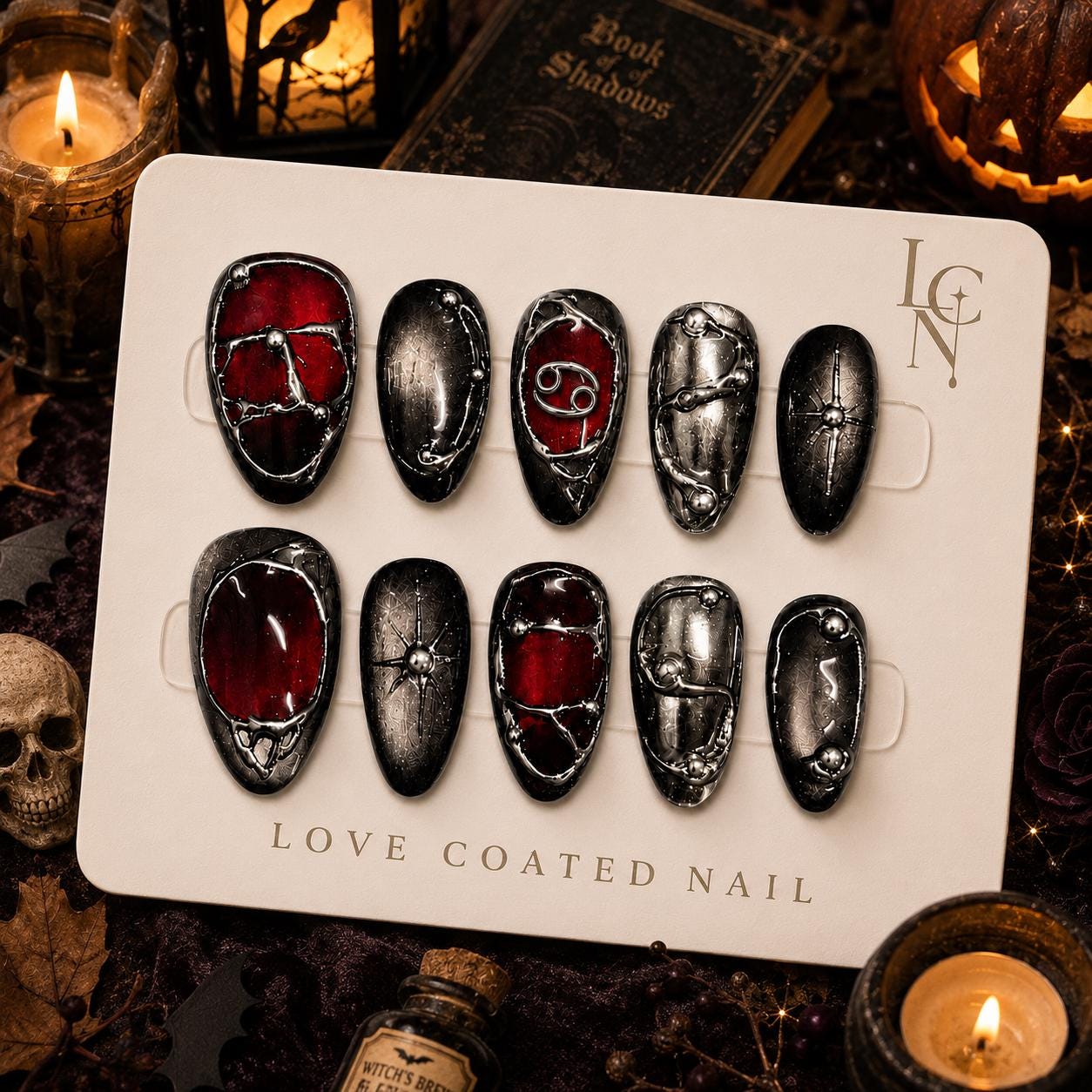
The almond shape offers the most balanced canvas for the dimensional blood‑red stained‑glass design on gothic press‑on nails, allowing the intricate chrome and jelly details to be seen from every angle without the silhouette overwhelming the artwork.
Visual Impact of Almond, Coffin, and Stiletto Silhouettes
Almond nails have a gently tapered tip that mirrors the natural curve of a fingertip. This shape creates a subtle elongation while preserving a relatively wide surface area near the tip. For the gothic press‑on set, the wide tip means the blood‑red stained‑glass panels and silver chrome accents sit squarely under the eye, making the depth of the jelly gel and metallic layers more apparent. The soft curve also reflects light in a way that highlights the glossy finish without creating harsh shadows.
Coffin (or ballerina) nails extend the length further and finish with a flat or slightly squared tip. The added length gives the stained‑glass artwork a dramatic runway, but the flat tip can truncate the visual flow of the design. When the stained‑glass pattern reaches the very edge, the flat surface may cut off part of the intricate details, especially if the artwork includes vertical motifs. However, the broader surface area of a coffin shape can accommodate larger pieces of the design, making it a good choice if the press‑on set features expansive stained‑glass panels.
Stiletto nails are the most extreme, with a sharply pointed tip that creates a dramatic silhouette. The point concentrates the visual focus toward the fingertip, which can be striking for a single bold element such as a central crimson jewel. Yet the narrow tip reduces the visible area for the stained‑glass pattern, often leaving only a sliver of the artwork visible. The pointed shape can also cast deeper shadows, which may obscure the subtle jelly translucency that gives the gothic nails their depth.
How Shape Affects Light Play and Depth Perception
The gothic press‑on nails rely on a combination of translucent jelly gel, metallic chrome pigments, and deep crimson accents to simulate stained‑glass windows. Light interaction is crucial: the jelly gel allows ambient light to pass through, while the chrome pigments reflect it, creating a layered, three‑dimensional effect. Almond nails, with their moderate length and rounded tip, let light enter from multiple angles and reflect off the chrome without excessive blockage. This results in a balanced glow that emphasizes the stained‑glass depth.
Coffin nails, being longer, can trap more light within the interior of the nail, especially when the design includes vertical lines that run the length of the nail. This can enhance the illusion of depth, but the flat tip may cause a slight loss of reflected light at the very end, making the final few millimeters appear flatter.
Stiletto nails, due to their sharp point, tend to direct light toward the fingertip, creating a concentrated highlight that can make the crimson jelly appear more saturated at the tip but dimmer along the shaft. If the stained‑glass design features a central motif, the stiletto can act like a spotlight, but the overall depth perception may suffer because less surface area is available for the layered pigments to interact with light.